 Pi & Planck
From the Universe to the Planck Length
Download high resolutionImage 4096×2304 (JPG)PDF for print
In short
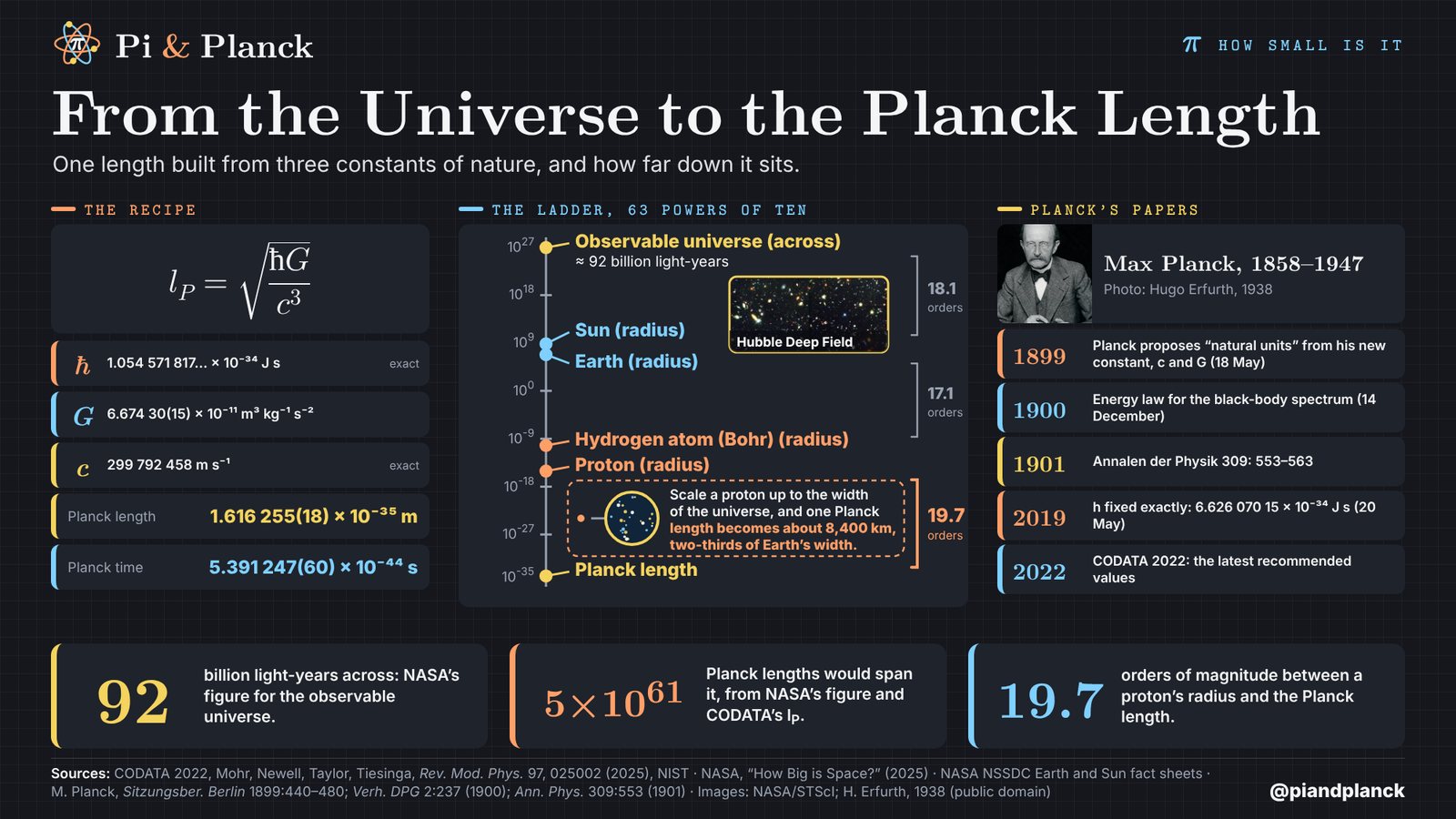
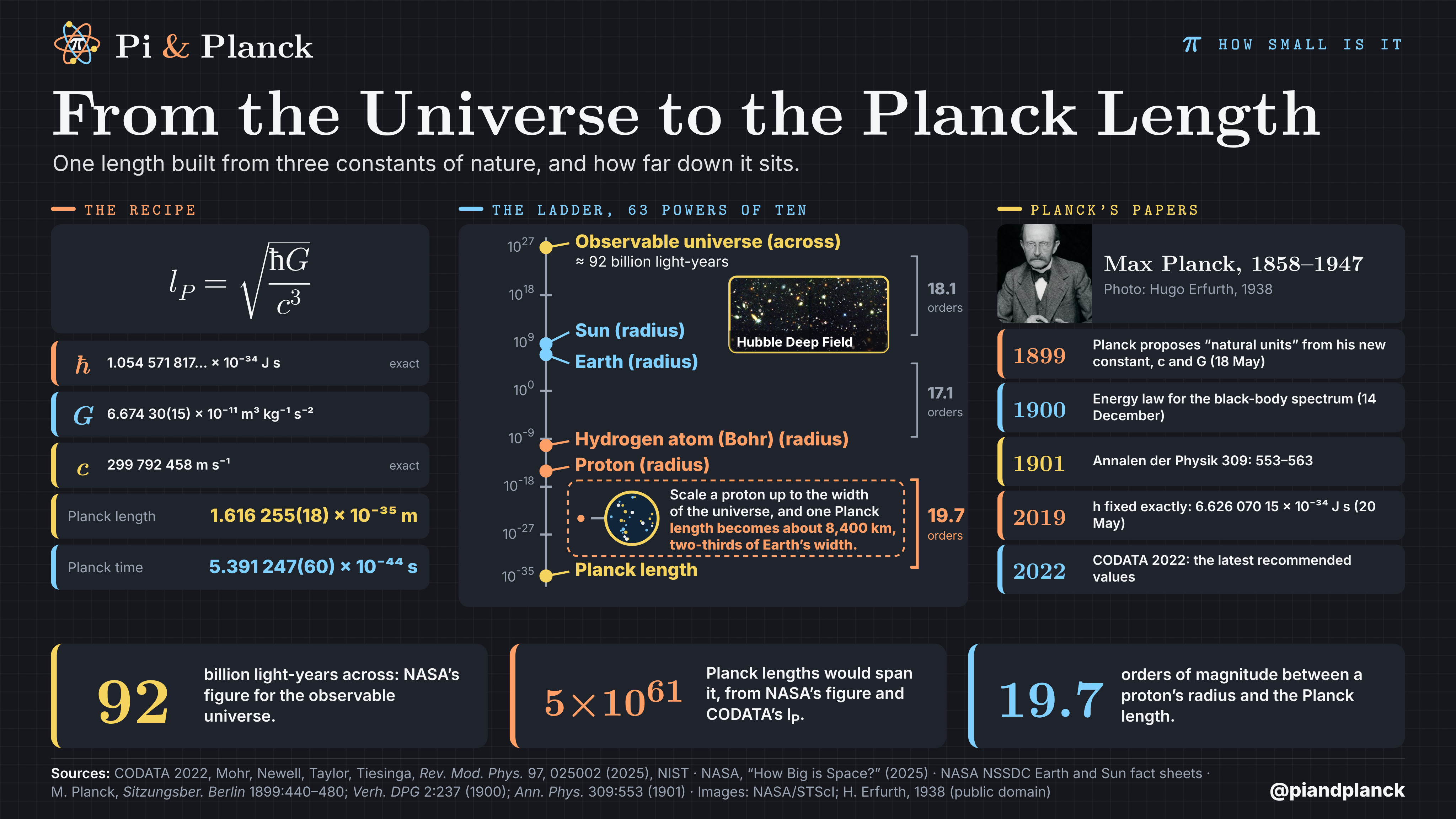
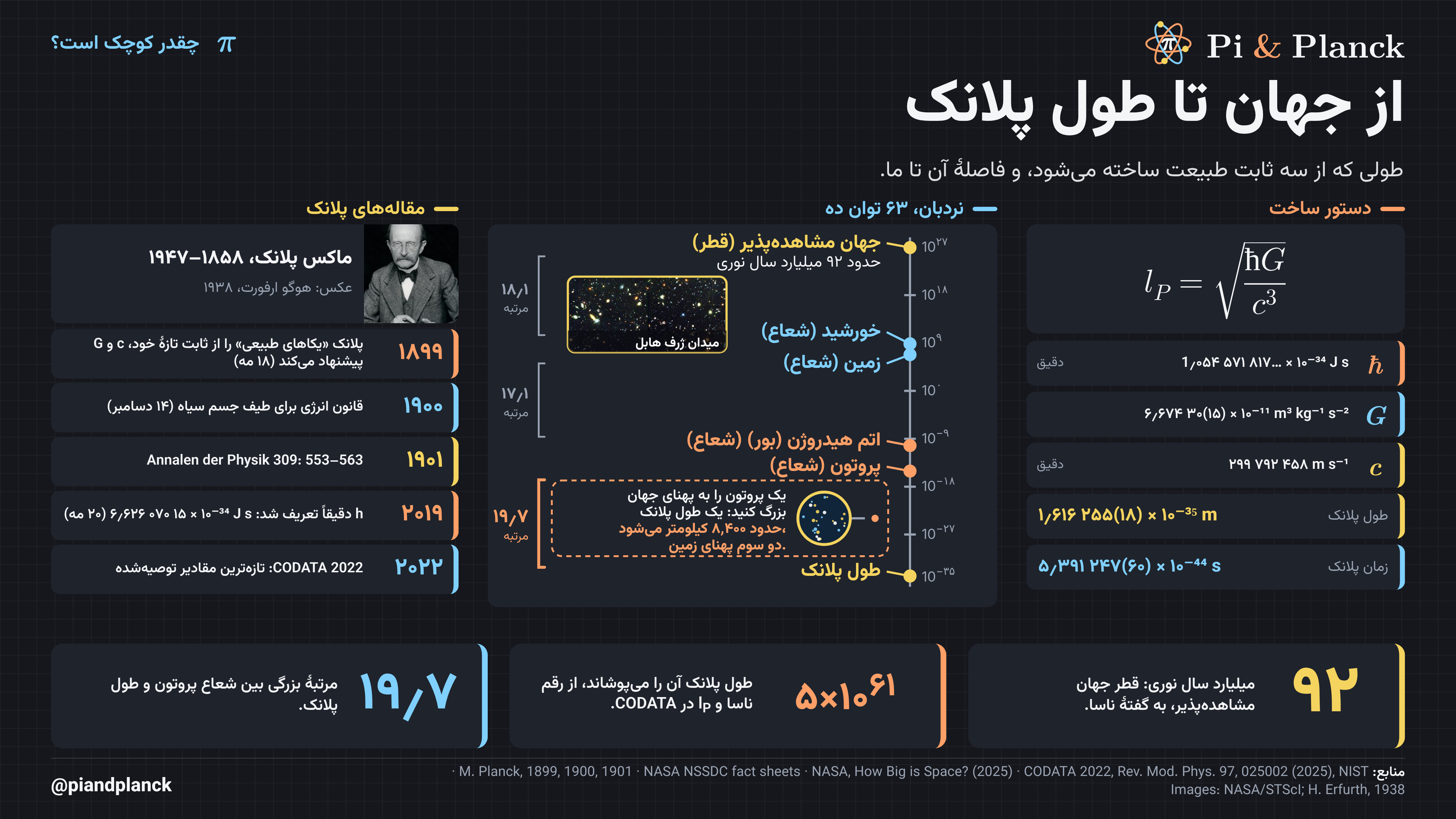
How small is the Planck length? 1.616 255 × 10^-35 m (CODATA 2022). About 5 × 10^61 of them would span the observable universe, which NASA puts at about 92 billion light-years across.
Sources
- P. J. Mohr, D. B. Newell, B. N. Taylor, E. Tiesinga, CODATA recommended values of the fundamental physical constants: 2022, Rev. Mod. Phys. 97, 025002 (30 April 2025), doi:10.1103/RevModPhys.97.025002; NIST extensive listing
- NASA, How Big is Space? We Asked a NASA Expert: Episode 61 (21 May 2025): the observable universe is about 92 billion light-years across
- NASA NSSDC Planetary Fact Sheets: Earth volumetric mean radius 6371.000 km; Sun volumetric mean radius 695,700 km
- M. Planck, Ueber irreversible Strahlungsvorgaenge, Fuenfte Mittheilung (Schluss), Sitzungsberichte Berlin 1899, 440-480 (session of 18 May 1899; natural units pp. 479-480)
- M. Planck, Zur Theorie des Gesetzes der Energieverteilung im Normalspectrum, Verhandlungen der DPG 2, 237-245 (14 Dec 1900)
- M. Planck, Ueber das Gesetz der Energieverteilung im Normalspectrum, Annalen der Physik 309, 553-563 (1901), doi:10.1002/andp.19013090310
- NIST SP 330 (2019), the SI Brochure: h fixed at 6.626 070 15 x 10^-34 J s (revised SI from 20 May 2019)
- Images: Tarantula Nebula NASA/JPL-Caltech (PIA23647); Helix Nebula NASA/JPL-Caltech/Univ. of Ariz. (PIA09178); Hubble Deep Field, R. Williams (STScI), the Hubble Deep Field Team and NASA; Max Planck, Hugo Erfurth, 1938 (public domain)
از جهان تا طول پلانک
دانلود با کیفیت بالاتصویر ۴۰۹۶×۲۳۰۴ (JPG)PDF چاپی
خلاصه
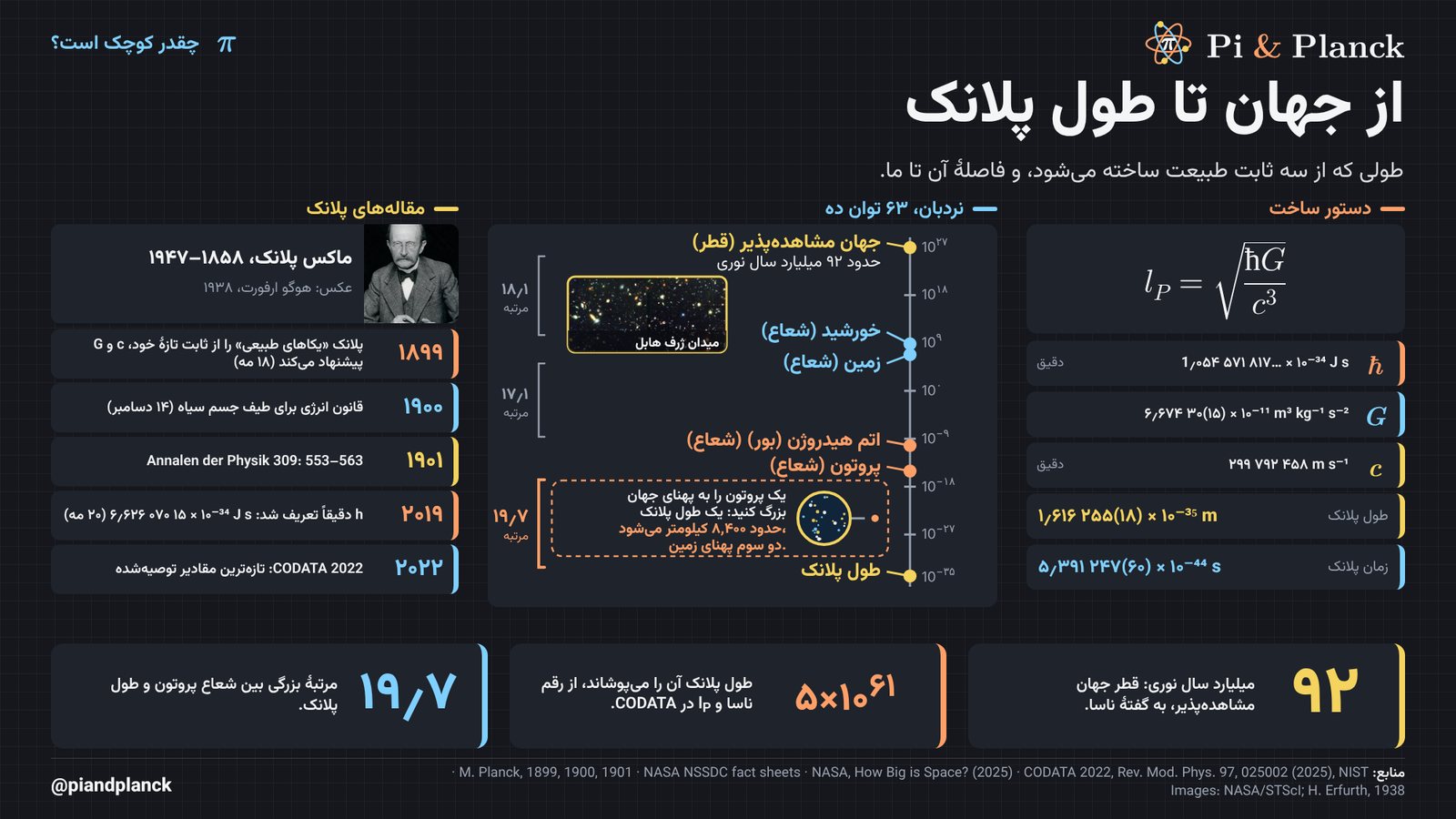
طول پلانک چقدر کوچک است؟ ۱٫۶۱۶ ۲۵۵ × ۱۰⁻³⁵ متر (CODATA 2022). حدود ۵ × ۱۰⁶۱ از آنها جهان مشاهدهپذیر را میپوشاند، که ناسا قطرش را حدود ۹۲ میلیارد سال نوری میداند.
منابع
- P. J. Mohr, D. B. Newell, B. N. Taylor, E. Tiesinga, CODATA recommended values of the fundamental physical constants: 2022, Rev. Mod. Phys. 97, 025002 (30 April 2025), doi:10.1103/RevModPhys.97.025002; NIST extensive listing
- NASA, How Big is Space? We Asked a NASA Expert: Episode 61 (21 May 2025): the observable universe is about 92 billion light-years across
- NASA NSSDC Planetary Fact Sheets: Earth volumetric mean radius 6371.000 km; Sun volumetric mean radius 695,700 km
- M. Planck, Ueber irreversible Strahlungsvorgaenge, Fuenfte Mittheilung (Schluss), Sitzungsberichte Berlin 1899, 440-480 (session of 18 May 1899; natural units pp. 479-480)
- M. Planck, Zur Theorie des Gesetzes der Energieverteilung im Normalspectrum, Verhandlungen der DPG 2, 237-245 (14 Dec 1900)
- M. Planck, Ueber das Gesetz der Energieverteilung im Normalspectrum, Annalen der Physik 309, 553-563 (1901), doi:10.1002/andp.19013090310
- NIST SP 330 (2019), the SI Brochure: h fixed at 6.626 070 15 x 10^-34 J s (revised SI from 20 May 2019)
- Images: Tarantula Nebula NASA/JPL-Caltech (PIA23647); Helix Nebula NASA/JPL-Caltech/Univ. of Ariz. (PIA09178); Hubble Deep Field, R. Williams (STScI), the Hubble Deep Field Team and NASA; Max Planck, Hugo Erfurth, 1938 (public domain)