 Pi & Planck
Noether’s Theorem
Download high resolutionImage 4096×2304 (JPG)PDF for print
In short
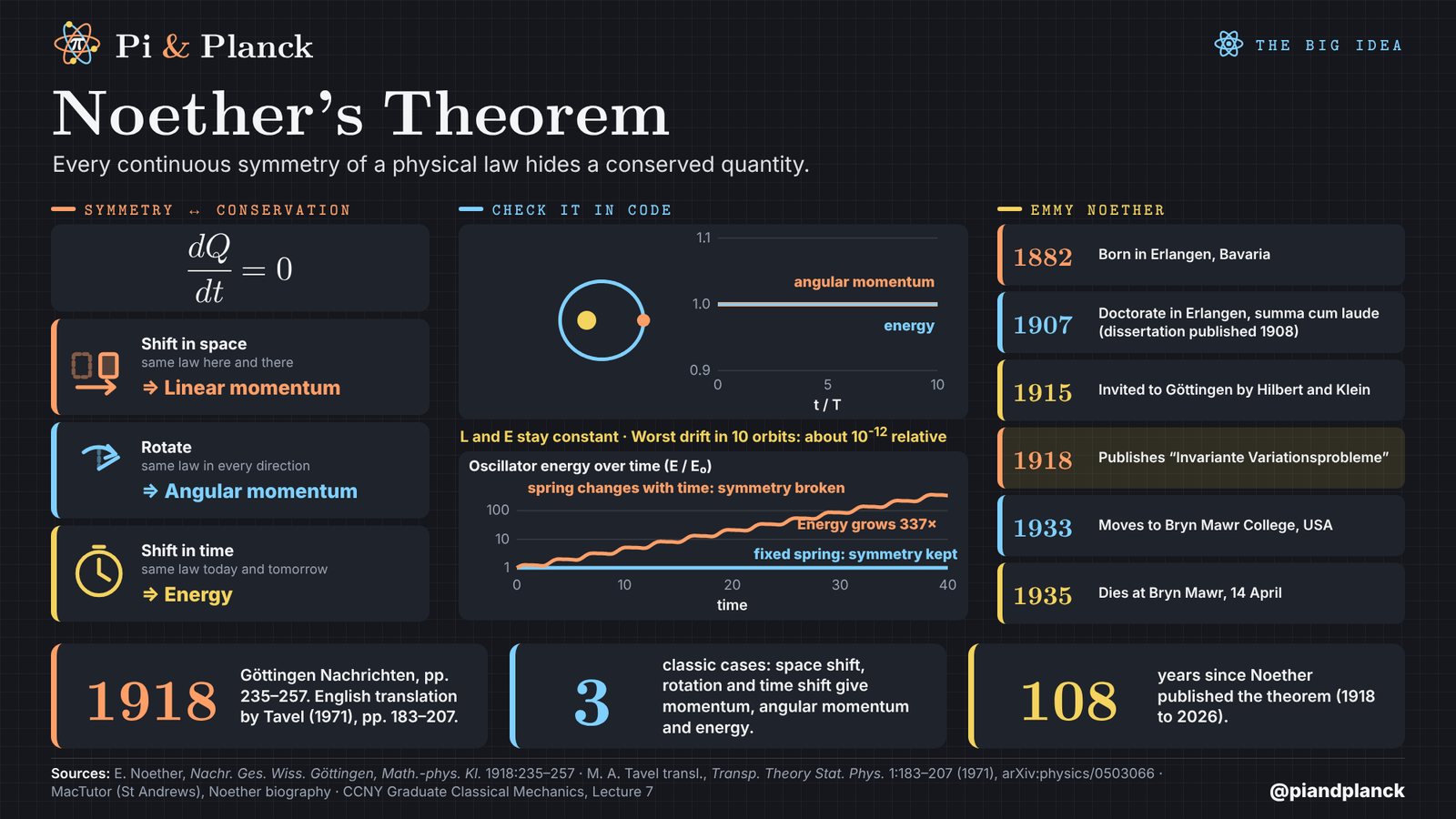
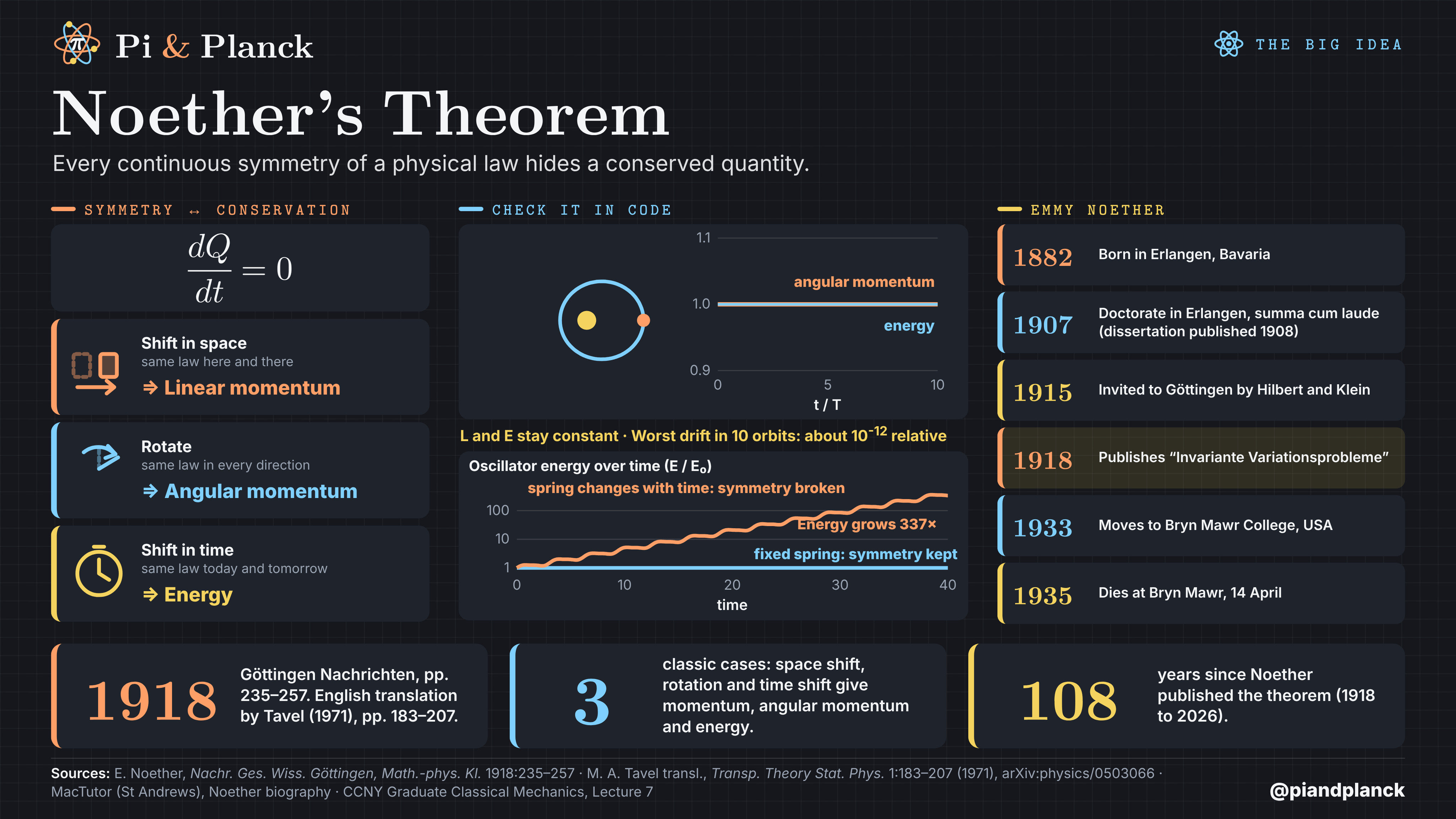
Noether's theorem: every continuous symmetry of a physical law hides a conserved quantity. Shift in space gives momentum, rotation gives angular momentum, shift in time gives energy. Published by Emmy Noether in 1918.
Sources
- E. Noether, Invariante Variationsprobleme, Nachrichten von der Gesellschaft der Wissenschaften zu Göttingen, Mathematisch-Physikalische Klasse, 1918, pp. 235-257 (Göttingen Digitalisierungszentrum scan)
- E. Noether, Invariant Variation Problems, transl. M. A. Tavel, Transport Theory and Statistical Physics 1(3), 183-207 (1971); arXiv:physics/0503066v3
- J. J. O'Connor, E. F. Robertson, Amalie Emmy Noether, MacTutor History of Mathematics, University of St Andrews
- Graduate Classical Mechanics, Lecture 7: Constraint Forces, Continuous Symmetry, and Noether's Theorem, City College of New York
- Orbit and oscillator numbers computed in this project (DOP853 integrator, rtol 1e-13)
- Photos: Göttingen engraving, Meyer's Universum vol. 5 (1838), public domain; W. A. Bentley snowflake No. 172, Smithsonian Institution Archives, CC0
قضیهٔ نوتر
دانلود با کیفیت بالاتصویر ۴۰۹۶×۲۳۰۴ (JPG)PDF چاپی
خلاصه
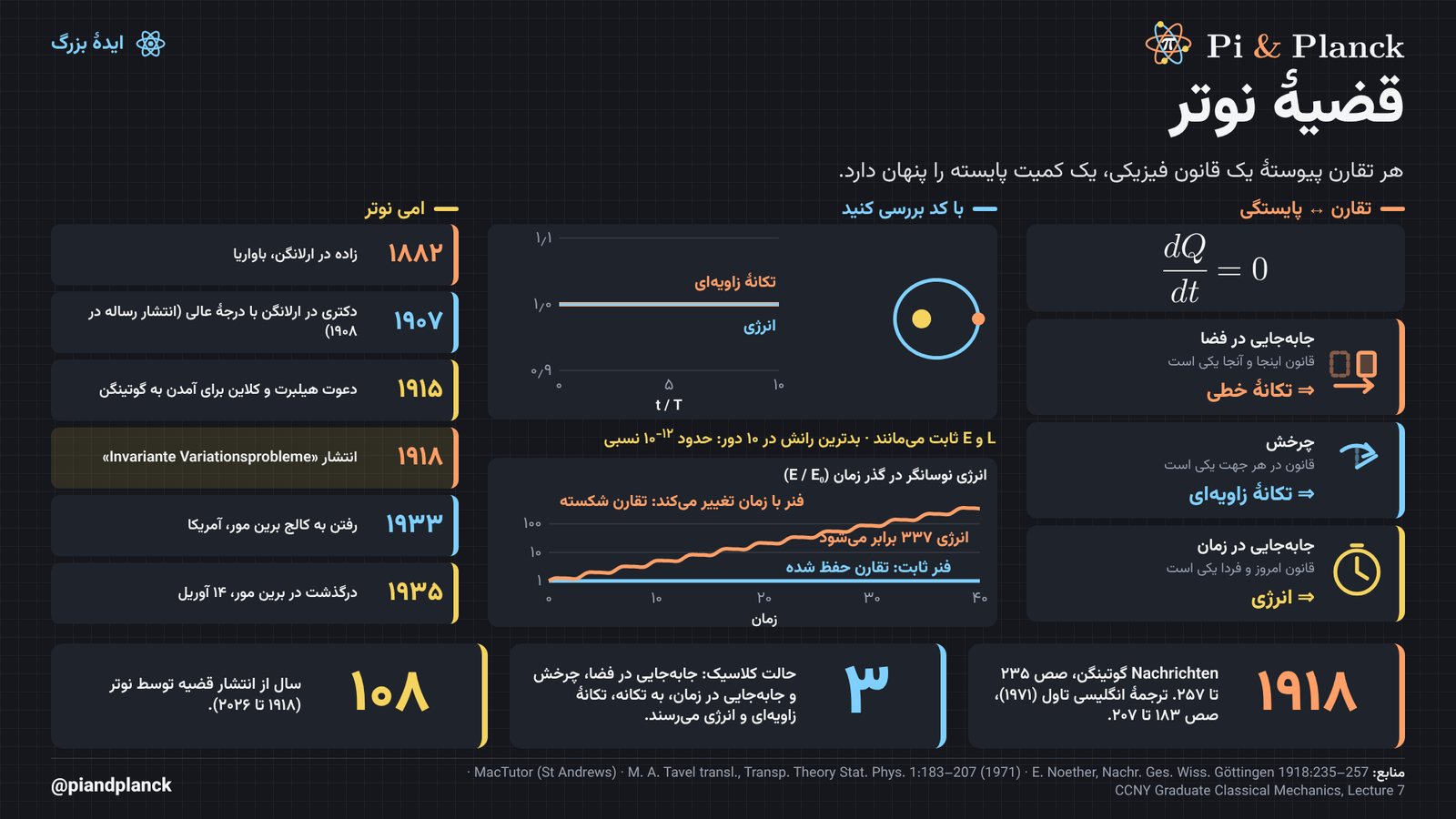
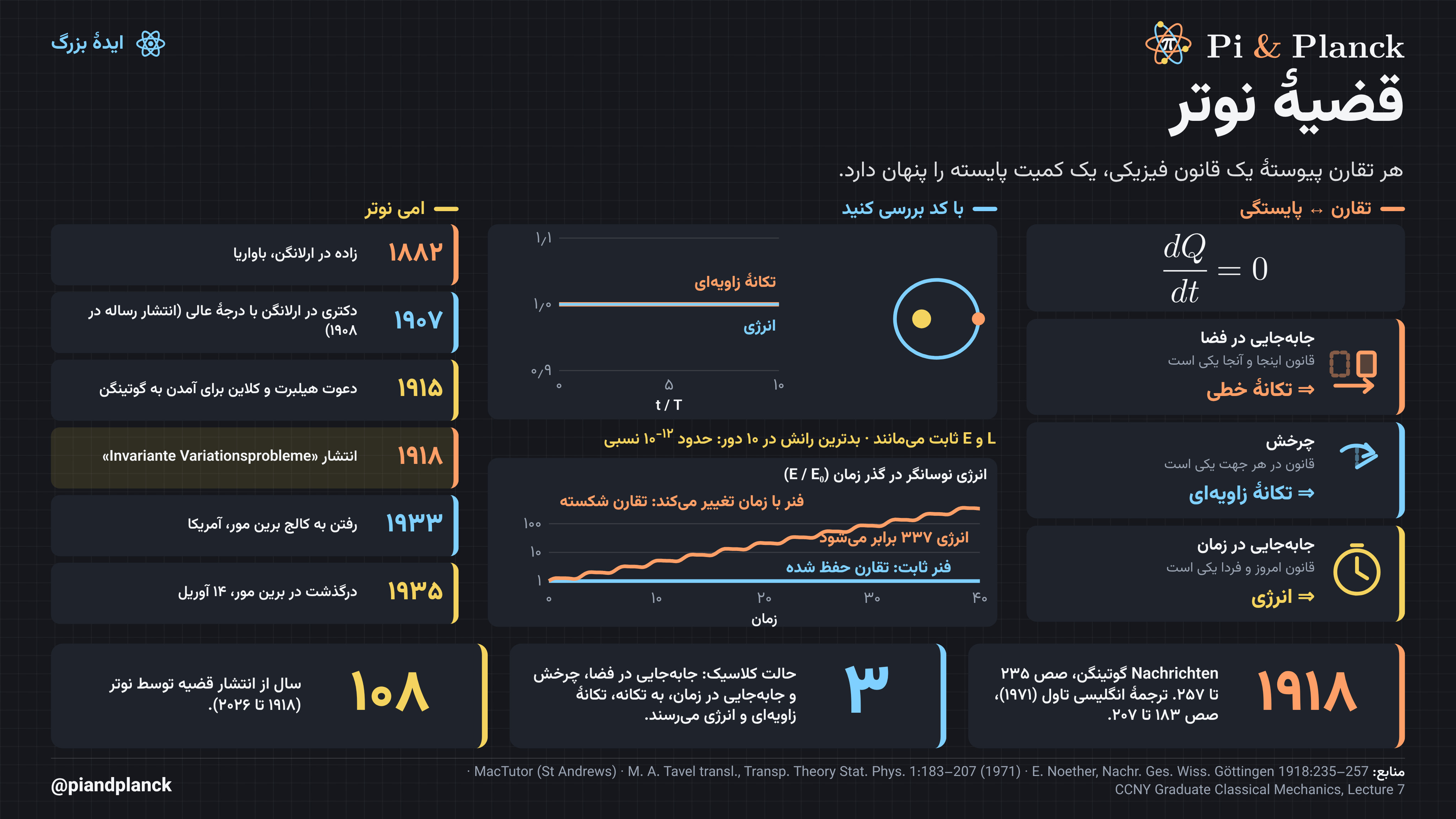
قضیهٔ نوتر: هر تقارن پیوستهٔ یک قانون فیزیکی، یک کمیت پایسته را پنهان دارد. جابهجایی در فضا تکانه میدهد، چرخش تکانهٔ زاویهای، و جابهجایی در زمان انرژی. امی نوتر آن را در ۱۹۱۸ منتشر کرد.
منابع
- E. Noether, Invariante Variationsprobleme, Nachrichten von der Gesellschaft der Wissenschaften zu Göttingen, Mathematisch-Physikalische Klasse, 1918, pp. 235-257 (Göttingen Digitalisierungszentrum scan)
- E. Noether, Invariant Variation Problems, transl. M. A. Tavel, Transport Theory and Statistical Physics 1(3), 183-207 (1971); arXiv:physics/0503066v3
- J. J. O'Connor, E. F. Robertson, Amalie Emmy Noether, MacTutor History of Mathematics, University of St Andrews
- Graduate Classical Mechanics, Lecture 7: Constraint Forces, Continuous Symmetry, and Noether's Theorem, City College of New York
- Orbit and oscillator numbers computed in this project (DOP853 integrator, rtol 1e-13)
- Photos: Göttingen engraving, Meyer's Universum vol. 5 (1838), public domain; W. A. Bentley snowflake No. 172, Smithsonian Institution Archives, CC0